
The TheraRadar Brief
Every drug has multiple stories. Most never get told.
Does Blocking IL-17F Actually Matter?
Two of the newest PsA drugs block IL-17F as well as IL-17A; the older ones block only IL-17A. A plain walk through what the extra target actually buys: clear help on the skin, no proven help on the joints yet, and a fungal cost in the middle.
Get the next TheraRadar Brief in your inbox
Drug development, biology, and market dynamics — free, every week.
Two of the newest psoriatic arthritis drugs, sonelokimab and bimekizumab, are built to block two closely related proteins at once: IL-17A and IL-17F. The older drugs in the same class, Cosentyx and Taltz, block only IL-17A.
This brief works through one question: does adding IL-17F actually help?
The short answer is that it clearly helps the skin, the joint benefit is not yet proven, and it carries a cost of its own. Here is how to see all three in the data.
What IL-17A and IL-17F are
IL-17A and IL-17F are close relatives. They are about half identical, they signal through the same receptor — a two-part complex of the proteins IL-17RA and IL-17RC — and they both switch on inflammation. The difference is strength and amount: IL-17A is the more powerful signal molecule for molecule (it binds IL-17RA more tightly), while IL-17F is weaker but more plentiful in inflamed tissue.
They also come in three forms: two IL-17A molecules paired together, two IL-17F molecules paired together, and a mixed A-plus-F pair. A drug that blocks only IL-17A, like secukinumab (Cosentyx) or ixekizumab (Taltz), clears the A pair and part of the mixed pair, and leaves the F pair active. A dual A/F drug catches all three.
How bimekizumab and sonelokimab block both cytokines
Bimekizumab takes the simple road. It is an ordinary Y-shaped antibody, and it works because the two cytokines look so alike. A patch on their surface is nearly identical on both, and bimekizumab's single binding site grips that shared patch, as its crystal structure with IL-17F confirms. Because the same patch sits on IL-17A, on IL-17F, and on the mixed A/F pair, one antibody neutralises all three. One binding site, three targets.
Sonelokimab takes the modular road, and does not rely on the two cytokines looking alike. It is a Nanobody, a much smaller molecule about a quarter the size of a normal antibody, built from three tiny single-domain binders strung together by flexible links. One grabs IL-17F, one grabs both IL-17A and F, and the third grabs albumin, an abundant, long-lived blood protein. That albumin grip does two jobs: it gives the drug a long half-life, and because albumin leaks into inflamed, swollen tissue, it helps the drug gather where the inflammation is. It is also small, so it slips into tissue more easily. Those two things are its pitch for doing more than a bigger antibody can.
Both end in the same place, blocking the A/A, A/F and F/F pairs alike. But bimekizumab gets there by making one arm that fits both, while sonelokimab bolts separate arms together and adds a delivery trick.
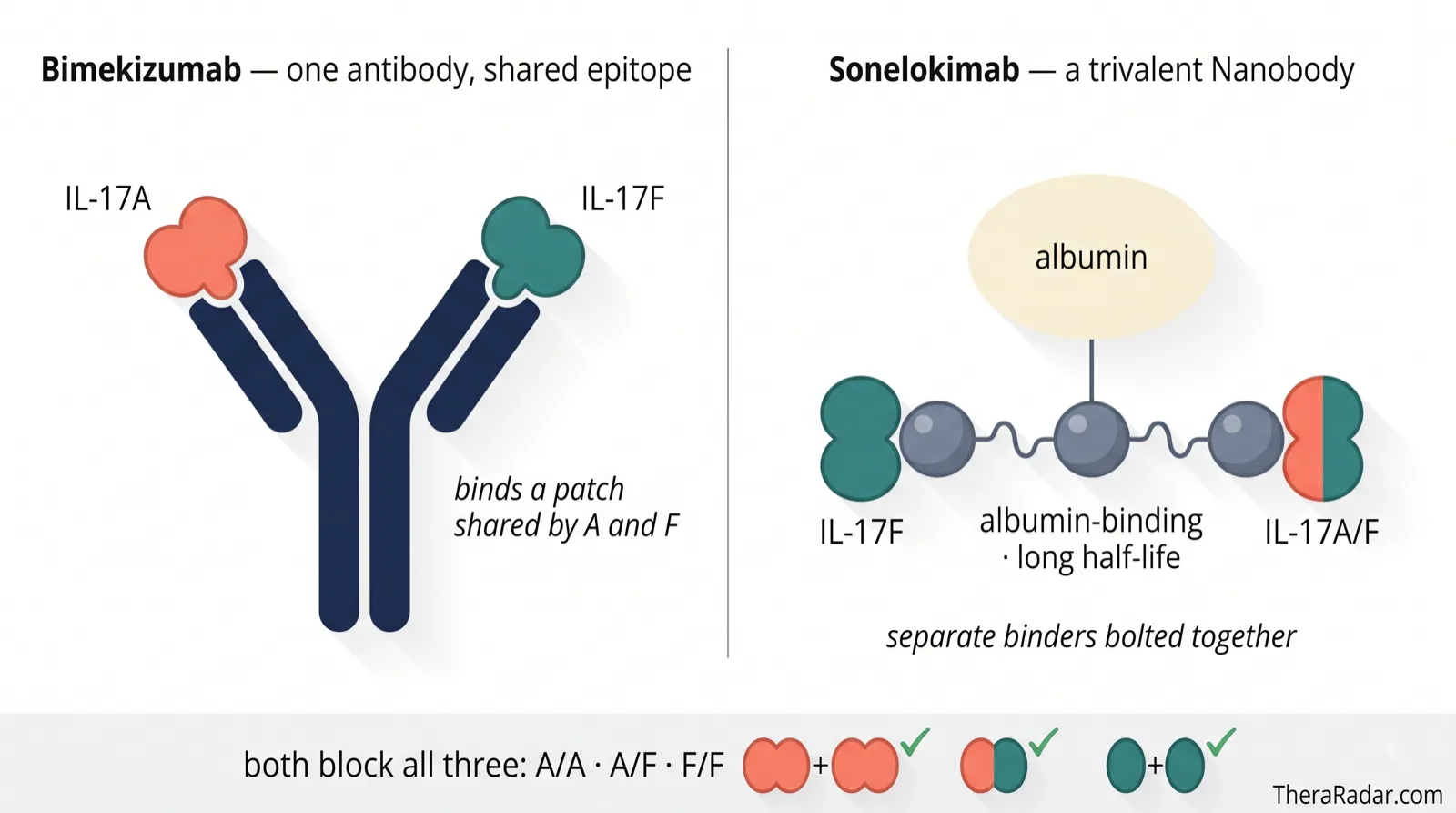
Bimekizumab is a conventional antibody whose binding site fits a patch shared by both cytokines. Sonelokimab is a small trivalent Nanobody with separate domains for IL-17F, IL-17A/F, and albumin (which gives it a long half-life). Both neutralise all three dimer forms — A/A, A/F and F/F.
TheraRadar.com
What the genetics say about IL-17
The target is also genetically real, which not every drug can claim: genome-wide studies of psoriasis and psoriatic arthritis keep flagging this pathway, including TRAF3IP2 — the gene for Act1, the adaptor that carries the IL-17 receptor's own signal — and IL23R one step upstream. The genetics even predict the trade-off. People born with a broken IL-17F gene or a missing IL-17 receptor get lifelong thrush (Puel et al., Science 2011), which showed the two cytokines are essential against Candida but otherwise largely redundant. Redundant enough to add little on the joints; essential enough to cost antifungal defence.
The idea behind the dual drugs is simple: if you also switch off IL-17F, you should get more. Whether that is true is something the trials can answer, and the answer turns out to depend on whether you look at the skin or the joints.
ACR50 and PASI90: the joint and skin scores
Psoriatic arthritis attacks the joints and, in most patients, the skin, so its trials report two kinds of result:
- ACR50 is the share of patients whose joint disease improved by at least 50%. Think of it as the joint score.
- PASI90 is the share of patients whose psoriasis cleared by at least 90%. Think of it as the skin score.
Here are the four drugs, with both scores side by side.
Joint score = ACR50; skin score = PASI90, in patients who also had psoriasis. Each figure comes from that drug's own PsA trial at its own timepoint, so this is not a head-to-head. The two dual A/F drugs are shaded.
| Drug | Blocks | Trial (patients) | Joints · ACR50 | Skin · PASI90 |
|---|---|---|---|---|
| Sonelokimab | IL-17A + F (Nanobody) | IZAR-1bio-naïve | 42.1% | 61% |
| Bimekizumab (Bimzelx) | IL-17A + F | BE OPTIMAL / BE COMPLETEbio-naïve / TNF-IR | 43.9% / 43.4% | 69% |
| Ixekizumab (Taltz) | IL-17A only | SPIRIT-P1 / P2bio-naïve / TNF-IR | 40% / 35% | n/v |
| Secukinumab (Cosentyx) | IL-17A only | FUTURE 2mixed | 35% | 33–49% |
Sonelokimab's placebo group is hidden until its programme ends, so its 42.1% cannot be adjusted for the placebo effect. Bimekizumab's skin figure is from BE COMPLETE (its BE OPTIMAL per-arm skin number was not broken out). "n/v" means not verifiable from a primary source in our data.
TheraRadar.com
Blocking IL-17F adds no proven joint benefit
On the joint score, the two dual drugs sit a little higher. Bimekizumab reached an ACR50 of about 44% in its trials, and sonelokimab reported about 42%. The two IL-17A-only drugs land around 35 to 40%. At first glance the extra target looks worth a few points.
But we cannot compare these numbers, because the trials differ in three ways:
- The measure. Bimekizumab and sonelokimab report ACR50 at week 16. Secukinumab and ixekizumab report their headline as ACR20 (a 20% improvement) at week 24, and their ACR50 is a secondary figure at a later point.
- The timing. Week 16 and week 24 are different checkpoints.
- The patients. Each trial enrolled a slightly different mix.
No trial has put a dual drug directly against an IL-17A-only drug in psoriatic arthritis. So that joint lead is only a guess from numbers that do not quite line up, not something a trial has shown. For now, treat the dual drugs as sitting in the same joint range as the ones they aim to replace.
Blocking IL-17F clears more skin
The skin score is cleaner. Among patients who also had psoriasis, bimekizumab cleared 90% of skin disease in roughly 61 to 69% of them, and sonelokimab reported 61%. Secukinumab, the class leader, reaches 33 to 49% depending on the dose. That gap is wider and steadier than anything on the joints.
The skin also has something the joints do not: a direct comparison. It comes from a psoriasis trial rather than a psoriatic arthritis one, but in the head-to-head BE RADIANT study, bimekizumab beat secukinumab on complete skin clearance (PASI100), the strictest bar there is. Two drugs in the same trial, and the dual one won on skin. That is the strongest evidence the IL-17F idea has so far, and it is a skin result.
This fits a broader pattern. The dual drugs help most in skin-driven disease — complete psoriasis clearance, and conditions such as hidradenitis suppurativa — while in the joint diseases, psoriatic arthritis and axial spondyloarthritis, their advantage over the IL-17A-only drugs is smaller.
Why IL-17F matters in skin but not joints
There is a concrete reason: where each cytokine is made. IL-17A is the more potent of the two, but in psoriatic skin IL-17F is the more abundantly expressed. A drug that blocks only IL-17A therefore leaves much of the skin's signal untouched; a dual drug removes IL-17F as well. In the joint the balance flips: IL-17A predominates in the synovium, where it has been measured at well over ten times the level of IL-17F. If we block IL-17F in the joint, it removes only a small fraction, so it makes little difference. But if we block IL-17F in the skin, it pays off the most, as IL-17F is relatively abundant.
The trade-off: more candidiasis (thrush)
The extra blockade is not free. IL-17A and IL-17F both help defend the moist surfaces of the body — the mouth, throat and skin folds — against Candida, a common yeast. Block both and you remove more of that defence than blocking IL-17A alone, so the dual drugs carry a higher rate of mild fungal infection, usually oral thrush, than the single-target drugs. In bimekizumab's psoriatic arthritis trials, Candida infections were more common than on placebo, though they were mild or moderate, none were systemic, and most cleared with antifungal treatment.
This is the cost side of the decision, and it is exactly why the joint-versus-skin split matters in practice. If a patient's psoriasis is severe, the deeper skin clearing can be well worth a manageable risk of thrush. If the joints are the main problem — where, as we saw, the dual drugs have no proven advantage — you have to ask whether blocking IL-17F buys enough to justify the added fungal risk at all.
Sonelokimab's real rival is bimekizumab
Because both make the same dual A/F bet, sonelokimab's real competitor is bimekizumab, not Cosentyx or Taltz. What separates them is the format we saw earlier: sonelokimab is the small, albumin-anchored Nanobody, bimekizumab the full-size antibody. IZAR-1 was built to start answering one question: does that smaller format deliver a better or longer-lasting response?
One caution about that result. MoonLake reported sonelokimab's 42% joint response on its own, without the placebo group, which stays hidden until the full programme finishes. Without the placebo number you cannot tell how much of the 42% is the drug and how much is the improvement every group in a trial tends to show. The figure is real, but it is not yet something you can line up against the others.
The takeaway: blocking IL-17F helps skin, not joints
Block IL-17F on top of IL-17A and, on today's evidence, the gain is mostly in the skin. It clears more psoriasis, and one head-to-head trial backs that up. On the joints, which are what define psoriatic arthritis, the dual drugs land in the same range as the drugs they mean to replace. The small edge in the numbers may be the difference between trials, not between drugs. And the extra blockade has a cost: a higher rate of mild fungal infection, easy to accept when the skin is the problem and harder to justify when it is the joints.
Sources & methods
- Efficacy figures: each drug's pivotal PsA trial, via the FDA label or primary publication, cross-checked against ClinicalTrials.gov results. Bimekizumab BE OPTIMAL (McInnes, Lancet 2023) / BE COMPLETE (Merola, Lancet 2023); secukinumab FUTURE 2 (McInnes, Lancet 2015); ixekizumab SPIRIT-P1/P2 (Mease, Ann Rheum Dis 2017; Nash, Lancet 2017). Full per-drug sourcing in our PsA efficacy dossier.
- Sonelokimab IZAR-1: MoonLake topline release, 10 August 2026. Placebo group not disclosed.
- Head-to-head skin data: BE RADIANT (Reich, NEJM 2021) — bimekizumab vs secukinumab in plaque psoriasis (PASI100), not PsA.
- Candidiasis: BE OPTIMAL safety data (McInnes, Lancet 2023) — more Candida infections on bimekizumab than placebo, all mild-to-moderate and non-systemic; and class reviews finding brodalumab and bimekizumab carry a higher candidiasis risk than secukinumab, consistent with the role of IL-17A and IL-17F in mucosal antifungal defence.
- IL-17 pathway genetics: Genome-wide association identifies a psoriasis susceptibility locus at TRAF3IP2 — Nature Genetics (2010); TRAF3IP2/Act1 and IL23R are associated with psoriasis and psoriatic arthritis.
- Inborn errors of IL-17 immunity: Puel et al., Chronic mucocutaneous candidiasis in humans with inborn errors of interleukin-17 immunity — Science (2011) — IL-17F and IL-17RA deficiency cause lifelong Candida infection.
- IL-17F in skin vs joint: IL-17F is the more abundantly expressed IL-17 cytokine in lesional psoriatic skin, whereas IL-17A predominates in the joint synovium. Primary evidence: Glatt et al., dual IL-17A/F neutralisation shows IL-17F contributes to human chronic tissue inflammation (Ann Rheum Dis 2018); differential IL-17A/F effects in synovium vs skin (Sci Rep 2023); reviewed in Front Immunol 2023.
- How the drugs bind both: bimekizumab grips a conserved epitope shared by IL-17A and IL-17F — crystal structure of the bimekizumab Fab with IL-17F (J Invest Dermatol 2024); sonelokimab is a trivalent Nanobody with three linked VHH domains (anti-IL-17F, anti-albumin, anti-IL-17A/F) — dual IL-17A/F inhibition review (2021).
- On comparing across trials: ACR and PASI responses shift with the endpoint, timepoint, and patient mix, so figures from separate trials are not a substitute for a head-to-head.
Spot an error? Reach out at hello@theraradar.com.
Frequently asked
IL-17A, IL-17F, and dual blockade in psoriatic arthritis
- What is the difference between IL-17A and IL-17F?
- They are close relatives — proteins about half-identical in sequence that signal through the same receptor (a complex of the IL-17RA and IL-17RC proteins) and both switch on inflammation. IL-17A is the more powerful signal molecule for molecule; IL-17F is weaker but more plentiful in inflamed tissue. They come in three forms: an IL-17A pair, an IL-17F pair, and a mixed A-plus-F pair. A drug that blocks only IL-17A leaves the F pair active; a dual A/F drug catches all three.
- Which psoriatic arthritis drugs block both IL-17A and IL-17F?
- Two. Bimekizumab (Bimzelx, UCB) is an approved dual IL-17A/F antibody, cleared for PsA in September 2024. Sonelokimab (MoonLake) is a Nanobody that also blocks both A and F; it met its primary endpoint in the Phase 3 IZAR-1 trial in August 2026 but is not yet filed. The established drugs secukinumab (Cosentyx) and ixekizumab (Taltz) block IL-17A only.
- Does blocking IL-17F improve joint outcomes in PsA?
- Not provably yet. The dual A/F drugs post ACR50 joint responses around 43–44%, and the IL-17A-only drugs around 35–40%. But those numbers come from different trials, measured differently, at different timepoints, so the gap is not a fair comparison and does not establish a joint advantage. No trial has directly compared a dual drug against an IL-17A-only drug in psoriatic arthritis.
- Does blocking IL-17F improve skin outcomes?
- Here the signal is clearer. Among PsA patients with psoriasis, bimekizumab cleared 90% of skin disease (PASI90) in about 61–69% of them, versus roughly 33–49% for secukinumab. And in a plaque psoriasis trial, BE RADIANT, bimekizumab beat secukinumab head-to-head on complete skin clearance (PASI100). The extra benefit of hitting IL-17F shows up mainly on the skin.
- Do the dual IL-17A/F drugs have more side effects?
- Their main distinctive side effect is mucosal candidiasis, usually mild oral thrush. IL-17A and IL-17F both help protect the mouth, throat and skin folds from Candida yeast, so blocking both removes more of that defence than blocking IL-17A alone. In bimekizumab's psoriatic arthritis trials, Candida infections were more common than on placebo, but they were mild or moderate, not systemic, and generally cleared with antifungal treatment. Brodalumab and bimekizumab carry a higher candidiasis risk than secukinumab.
- Do human genetics support blocking IL-17 in psoriatic arthritis?
- Yes. Genome-wide studies of psoriasis and psoriatic arthritis repeatedly implicate the IL-23/IL-17 pathway, including TRAF3IP2 — the gene for Act1, the adaptor that carries the IL-17 receptor's signal into the cell — and IL23R one step upstream. Separately, people born with a faulty IL-17F gene or with IL-17 receptor (IL-17RA) deficiency develop chronic mucocutaneous candidiasis, which shows that IL-17A and IL-17F are essential for antifungal defence but otherwise largely redundant. That finding explains both why dual blockade adds little on the joints and why it raises the risk of thrush.
- Why can't sonelokimab's 42.1% be compared directly to the other drugs?
- MoonLake reported sonelokimab's 42.1% joint response (ACR50 at Week 16) on its own, keeping the placebo group hidden until its full Phase 3 programme finishes. Without the placebo number you cannot tell how much of that 42.1% is the drug and how much is the improvement every trial arm tends to show. It also used a different endpoint and timepoint from the older drugs. The figure is real; it just cannot be lined up against a bimekizumab or secukinumab number.
Related briefs
- Fifteen Drugs by Blocking. None by Switching On. — how one immunology cytokine family gets drugged, and how it does not.
- Entyvio: The Only IBD Drug That Stays in the Gut — when one small change to a mechanism is the whole product.
Go deeper with Pro
Pro gives you the data — patent cliffs, trial analytics, competitive landscapes, revenue tracking. Briefs tell the story with the data. Launch pricing: $99/month.
See Pro plansGet the next Brief in your inbox — free
Every drug has multiple stories. Most never get told. One brief every week. No spam.
Archive at /briefs/. Unsubscribe anytime.