
The TheraRadar Brief
Every drug has multiple stories. Most never get told.
Entyvio: The Only IBD Drug That Stays in the Gut
Eleven years after approval, Entyvio remains the only IBD drug that acts only in the gut — and two large pharma programs have failed trying to replicate it.
Get the next TheraRadar Brief in your inbox
Drug development, biology, and market dynamics — free, every week.
Integrins are two-piece molecules — an α chain plus a β chain — that lymphocytes use as zip codes to find the right tissue. Vedolizumab pairs α4 with β7 and routes lymphocytes to the gut alone. Pair α4 with β1 and they go everywhere, including the brain, where blocking them can cause fatal infections. That choice built a $6 billion drug.
Entyvio — the brand name for the monoclonal antibody vedolizumab — is the single largest product Takeda sells. It generated $6.39 billion in fiscal year 2026 (year ended March 31, 2026) and has grown every year since launch. The FDA approved it in 2014 for both ulcerative colitis and Crohn's disease in a single decision — the first biologic ever cleared for both at once. What makes it uniquely gut-selective is the difference between two integrin pairs: α4β7, which binds an adhesion molecule expressed almost exclusively in the gut, and α4β1, which binds adhesion molecules expressed broadly across the body. Vedolizumab targets only α4β7.
Lymphocyte homing: how immune cells find their target tissue

Lymphocytes do not roam at random. The human body holds roughly a trillion lymphocytes in total — tens of billions in active circulation in the bloodstream at any given moment, the rest distributed across lymph nodes, spleen, bone marrow, and tissue compartments. The immune system needs to send the right cells to the right tissues — naïve cells to lymph nodes to sample new antigens, gut-protective cells to the intestine, virus-fighting cells to whatever tissue is currently infected. Without targeted routing, mucosal defenses would not exist as a specialized system, and infections would clear no faster than random circulation allowed.
The routing problem is real, and the immune system solves it with something that works like a postal address system: each tissue puts up its own characteristic "address," and circulating lymphocytes carry the molecular "reader" that recognizes it.
On the lymphocyte side: integrins — heterodimeric surface proteins that, when activated, bind matching ligands on blood-vessel endothelial cells. On the endothelial side: addressins — adhesion molecules whose expression patterns are restricted to particular tissues.
When a lymphocyte's integrin matches the addressin on a stretch of endothelium, a four-step adhesion cascade fires: the cell tethers loosely, rolls along the vessel wall under blood flow, firmly adheres when activating signals from local chemokines snap its integrins into a high-affinity conformation, and finally squeezes between endothelial cells into the underlying tissue. The whole sequence takes seconds, happens millions of times a day across the human vascular tree, and is exquisitely tissue-specific. Each tissue has its own characteristic combination of addressins; each circulating lymphocyte carries an integrin signature that determines where it can stop.
The framework was worked out in the 1980s and 1990s by Eugene Butcher, Tim Springer, and a small group of immunologists who established what is now called the homing-receptor paradigm — and which drug developers would eventually try to exploit.
MAdCAM-1 and α4β7: the gut's address code
The gut has its own address. MAdCAM-1 — mucosal addressin cell adhesion molecule 1 — is expressed almost exclusively on the high endothelial venules of gut-associated lymphoid tissue, mesenteric lymph nodes, and intestinal lamina propria venules. The integrin that recognizes MAdCAM-1 is α4β7. Lymphocytes get imprinted with α4β7 in inductive sites like Peyer's patches, where retinoic acid produced by gut dendritic cells upregulates the integrin's expression. Once an α4β7+ lymphocyte enters circulation, it preferentially returns to the gut. This is what makes IBD a disease of dysregulated gut-homing immunity: too many α4β7+ cells, recruited too efficiently to MAdCAM-1-expressing gut endothelium, driving inflammation.
The other half of α4 — α4β1 — binds a different addressin: VCAM-1. VCAM-1 is broadly expressed on activated endothelium across the body. In the CNS, VCAM-1 expression on white-matter microvessels rises under inflammatory conditions, and α4β1/VCAM-1 binding mediates the rate-limiting capture of T-cell blasts at the blood-brain barrier. It is also the route by which CD8+ T cells maintain CNS surveillance against viral reactivation — including reactivation of the latent JC virus that lives in roughly half of healthy adults.
By the late 1990s, the immunology field had worked out the basic shape of this two-axis system: α4β7 for gut homing, α4β1 for trafficking across activated endothelium throughout the body, including the brain. The question for drug developers was whether the two could be separated. If a molecule could block α4β7 without touching α4β1, it should suppress gut inflammation without affecting CNS surveillance. That hypothesis was the seed of Entyvio.
Millennium makes the bet (1996–2007)
Millennium Pharmaceuticals was a Cambridge biotech founded in 1993, built around the then-novel idea that human genomics would accelerate drug discovery. By the late 1990s it had assembled an inflammation and autoimmune disease program and was looking for differentiated mechanisms. The α4β7-selective hypothesis fit. The molecule that would become vedolizumab — internally MLN02, originally licensed from LeukoSite, which Millennium acquired in 1999 — was a humanized IgG1 monoclonal antibody engineered to bind specifically to the α4β7 heterodimer. It does not bind α4β1 or αEβ7. That selectivity was the entire point.
The early clinical data was encouraging. Feagan and colleagues published a placebo-controlled Phase 2 study of MLN02 in active ulcerative colitis in the New England Journal of Medicine in 2005: clinical remission at week 6 was 33% in the higher-dose group versus 14% on placebo. A parallel Phase 2 in Crohn's disease showed a smaller but real signal. The selectivity hypothesis was working — α4β7 blockade alone was producing measurable clinical responses in IBD.
Millennium took the program to Phase 3 around 2007 with an unusually ambitious plan: seek simultaneous approval in both ulcerative colitis and Crohn's disease — something no biologic had ever done. The trials, which would become known as GEMINI, were powered to carry the efficacy story on their own; Millennium believed the α4β7-only selectivity profile would carry the safety story without needing subgroup arguments after the fact.
While Millennium worked, Tysabri changed the class
At almost exactly the same time Millennium was advancing MLN02 through early development, the broader α4 integrin class was undergoing the most consequential reframing in its history. Natalizumab — sold as Tysabri, developed by Biogen and Elan — was a pan-α4 antibody that bound the α4 subunit on lymphocytes, blocking both α4β7 (gut homing) and α4β1 (CNS trafficking). Tysabri was approved by the FDA on November 23, 2004 for relapsing multiple sclerosis. Three months later, in February 2005, Biogen voluntarily withdrew the drug from the market. Two patients in the SENTINEL MS trial and one Crohn's patient in a separate trial had developed progressive multifocal leukoencephalopathy — a normally rare brain infection caused by reactivation of the JC virus. PML is fatal in roughly a quarter of cases and leaves most survivors with significant neurological disability.
The mechanism turned out to be exactly what the α4β7/α4β1 separation had implied was possible. Tysabri's MS benefit came from α4β1 blockade stopping autoreactive lymphocytes from crossing the blood-brain barrier. But the same α4β1 blockade also stopped CD8+ T cells whose job was to patrol the brain for reactivating viruses. In the small subset of patients carrying the JC virus, the result was occasionally catastrophic. Pan-α4 blockade had pulled the IBD axis (α4β7) and the CNS surveillance axis (α4β1) at the same time. The two effects were inseparable in one molecule.
In June 2006, Tysabri was re-approved under a restricted distribution and monitoring program called TOUCH (Tysabri Outreach Unified Commitment to Health). Prescribers, infusion centers, and pharmacies must be TOUCH-enrolled. Patients get baseline anti-JCV antibody testing using the STRATIFY JCV assay, periodic re-testing, and regular MRIs to screen for early PML lesions. The label carries a boxed warning. In January 2008, the FDA approved Tysabri for moderately-to-severely active Crohn's disease — restricted to patients who had failed or could not tolerate anti-TNFs. Biogen would eventually report 541 cumulative cases of PML in natalizumab-treated patients through 2015, with risk concentrated in anti-JCV-positive patients with prior immunosuppressant exposure and more than 24 months of treatment.
For Millennium, the Tysabri arc cut both ways. It validated the central premise — α4-axis blockade really did treat IBD — while demonstrating exactly why pan-α4 was the wrong way to do it. If vedolizumab's α4β7-only selectivity held up in Phase 3, it would solve the problem that had restricted Tysabri to refractory disease behind a federal monitoring program. The bet that became Entyvio was that the dual mechanism of Tysabri's IBD efficacy was actually two separable mechanisms, and only one of them mattered for the gut.
Takeda inherits the program (2008)
In April 2008, Takeda announced the acquisition of Millennium Pharmaceuticals for approximately $8.8 billion. The headline asset was Velcade (bortezomib), Millennium's blockbuster multiple myeloma drug. Vedolizumab was further down the priority list — an IBD candidate just entering Phase 3, in a class that had been redefined by Tysabri's safety problems three years earlier. Takeda inherited it mid-development.
Takeda already led Japanese pharma and was expanding in the US and Europe. IBD was a strategic fit: the dominant therapies were anti-TNFs and a TOUCH-restricted Tysabri, leaving room for a biologic with a cleaner safety story. Vedolizumab was the most clinically advanced asset on the immuno-inflammation platform Takeda had just bought, and the GEMINI program continued on schedule.
GEMINI and a historic first (2009–2014)
Takeda ran the three pivotal Phase 3 trials Millennium had designed: GEMINI 1 in ulcerative colitis, GEMINI 2 in Crohn's disease, and GEMINI 3 in Crohn's patients who had failed anti-TNF therapy. The trial designs separated induction and maintenance phases, so the same patient population could be re-randomized within the same study after responding to induction.
GEMINI 1 (Feagan et al., NEJM 2013) randomized 374 patients with moderate-to-severe ulcerative colitis to vedolizumab induction or placebo. At week 6, 47.1% of vedolizumab patients had clinical response compared to 25.5% on placebo. Week-6 responders were re-randomized into the maintenance phase (n=373) and followed for a year. Clinical remission at week 52 was 41.8% on every-8-week dosing, 44.8% on every-4-week dosing, and 15.9% on placebo. All endpoints met.
GEMINI 2 (Sandborn et al., NEJM 2013) tested the same approach in 368 patients with moderate-to-severe Crohn's disease. The induction primary — clinical remission at week 6 — was met at 14.5% vedolizumab versus 6.8% placebo (p=0.02), but the co-primary CDAI-100 response endpoint missed at week 6. Maintenance results in the 461-patient extension cohort were cleaner: remission at week 52 was 39.0% on Q8W dosing, 36.4% on Q4W, and 21.6% on placebo. The Crohn's signal was real but emerged more slowly than the UC signal — a pattern that has held in real-world use.
GEMINI 3 (Sands et al., Gastroenterology 2014) tested vedolizumab specifically in Crohn's patients who had failed at least one anti-TNF. The primary endpoint — clinical remission at week 6 — was not met (15.2% vedolizumab vs 12.1% placebo). At week 10, however, remission was 26.6% vs 12.1% (p=0.001). The trial established that vedolizumab works in anti-TNF-experienced Crohn's, but with a slower onset than in biologic-naïve patients.
No PML cases occurred across the three pivotal trials or their open-label extensions. This was the selectivity prediction operating in real patients: with α4β1 preserved, CNS surveillance against JC virus stayed intact, and the brain-infection risk that defined Tysabri's IBD label did not appear.
On May 20, 2014, the FDA approved vedolizumab — branded Entyvio — for both moderate-to-severe ulcerative colitis and moderate-to-severe Crohn's disease in adults, simultaneously. It was the first biologic ever approved for both IBD indications at the same time. The label covered both biologic-naïve and anti-TNF-experienced patients. Two days later, on May 22, 2014, the European Commission approved Entyvio for the same indications on the strength of the same GEMINI dataset.
A million patient-years: the bet held
The mechanistic prediction — vedolizumab should not cause PML — has held up across the largest dataset that the question has ever been asked of. Takeda reports more than one million cumulative patient-years of vedolizumab exposure across IV and subcutaneous use globally as of 2024-era materials.
In GEMINI LTS, the long-term safety extension that followed patients from the original Phase 3 trials, Loftus and colleagues published 7,999 patient-years of follow-up with zero confirmed cases of PML. In the broader pivotal clinical-trial program of more than 6,000 patients, no PML cases were reported. In a 2025 prospective post-authorization safety study with 5,008 patients followed for a mean of 37 months, no PML cases were reported.
The one exception is informative. Through approximately 470,000 post-marketing patient-years analyzed by Loftus and colleagues in 2018, there was one confirmed PML case in a vedolizumab-treated patient — a patient with HIV and a low CD4 count, already severely immunodeficient at diagnosis. The honest version of the safety story is therefore "one confirmed case in over a million patient-years, in a patient with severe HIV-associated immunodeficiency" rather than "zero PML." The distinction matters because the underlying mechanism — preserved CNS T-cell surveillance — is what makes the safety profile believable in the first place. If a patient's immune system is already destroyed, the surveillance benefit of α4β7 selectivity does not rescue them.
The regulatory consequence is direct: Entyvio has no REMS. There is no required anti-JCV screening. There is no MRI surveillance. Any gastroenterologist can prescribe it as standard care. That is the practical realization of the selectivity bet Millennium made in the late 1990s and Takeda inherited in 2008 — translated into the day-to-day clinical experience of every Entyvio patient.
The fair counterpoint is speed. Vedolizumab response emerged at six to twelve weeks in GEMINI — more gradual than anti-TNFs or JAKs, and slower in Crohn's than in UC. In practice, gastroenterologists pair vedolizumab with a corticosteroid bridge during induction, and patients with severe acute UC typically start on infliximab or a JAK instead. The split has settled into a clear division of labor: vedolizumab for chronic maintenance and biologic-naïve moderate disease, faster agents for severe acute flares.
VARSITY: beating Humira at its own job (2019)
Most biologics in IBD hold their commercial position on placebo-controlled efficacy and physician preference, because head-to-head randomized trials between biologics are rare. VARSITY (Sands et al., NEJM 2019) is the exception. The trial randomized 769 patients with moderate-to-severe ulcerative colitis to vedolizumab or adalimumab — the dominant anti-TNF in the disease — and followed them for a year on each maintenance regimen.
At week 52, clinical remission was 31.3% on vedolizumab versus 22.5% on adalimumab, p=0.006. Endoscopic improvement was 39.7% versus 27.7%. Vedolizumab was superior on the primary endpoint. The one place adalimumab held its own was corticosteroid-free remission, where the difference did not reach significance. But on the clinical and endoscopic outcomes that drive the prescribing decision in moderate-to-severe UC, vedolizumab won directly against the longtime market leader.
VARSITY is the strongest piece of head-to-head evidence in any IBD biologic comparison. It is the trial vedolizumab can still point to a decade after approval — and a counterweight to the criticism that gut-selectivity comes at a cost in efficacy. In moderate UC, against the most-prescribed anti-TNF, it did not.
Try TheraRadar Pro — 30 days free, no credit card
Patent cliff dashboards, watchlists, alerts, head-to-head company tools.
The challengers who dropped out (2017–2022)
Once vedolizumab proved gut-selective trafficking blockade worked in IBD, competitors came at the target from three directions: copy it with another α4β7 antibody, hit a different integrin pair in the same axis, or hit the addressin on the other side of the same interaction. None reached the market — but for different reasons. One met its Phase 2 endpoint and was abandoned anyway; the other two failed in Phase 3.
Abrilumab was the closest copy — a fully human anti-α4β7 antibody from Amgen and AstraZeneca's MedImmune (AMG 181 / MEDI-7183), aimed at exactly the integrin pair vedolizumab targets. Its Phase 2b trial in ulcerative colitis (Sandborn et al., Gastroenterology 2018; 354 patients) met its primary endpoint: remission at week 8 was 13.3% on the 70-mg dose and 12.7% on 210 mg, versus 4.3% on placebo (odds ratios 3.35 and 3.33; p=0.021 and 0.030), with clinical response and mucosal healing also significantly better than placebo. And as the selectivity hypothesis predicted, there were no cases of PML and no deaths — a second, independently developed α4β7-selective antibody reproducing the same efficacy-without-brain-risk profile. Amgen and AstraZeneca never advanced it to Phase 3, discontinuing the program for portfolio reasons rather than any efficacy or safety problem. By the time it read out, vedolizumab was approved and entrenched, and the commercial case for a second gut-selective antibody had narrowed.
Etrolizumab was Roche's bet on dual β7 blockade — binding the β7 subunit to block both α4β7 (gut homing) and αEβ7 (T-cell retention in the gut epithelium), in theory delivering richer mucosal healing than vedolizumab. Roche ran six Phase 3 trials across UC and Crohn's. The August 2020 readout was mixed — some endpoints met, most missed. In February 2022 Roche discontinued the final Crohn's program. The β7 dual-blockade hypothesis was abandoned; analyst estimates put the investment over a billion dollars.
Ontamalimab took the opposite approach: a monoclonal antibody against MAdCAM-1 on the gut endothelium, rather than the integrin on the lymphocyte. Originally Pfizer's PF-00547659, licensed to Shire in 2016 and inherited by Takeda after the 2019 Shire acquisition. Phase 2 efficacy was real (TURANDOT in UC, OPERA in Crohn's). But the Phase 3 program (FIGARO and CARMEN) was discontinued in 2020 for portfolio reasons. Takeda never publicly attributed it to efficacy failure; the program was simply shelved.
Two biologically rational extensions of the gut-selective concept both stalled. The likely reasons: α4β7 blockade may already be sufficient (additional axes yield no incremental gain); modern Phase 3 endpoints are stricter; integrin mechanisms underperform IL-23 or JAK approaches in heavily anti-TNF-experienced populations; and by the time these readouts arrived, IL-23s and JAKs had taken the commercial oxygen.
From infusion to pen: the second act (2020–2024)
The original Entyvio formulation was an intravenous infusion administered at induction and every eight weeks thereafter. For nine years in the United States, that was how every Entyvio patient received the drug — a half-day visit to an infusion suite, six or seven times a year. The patient experience was the most obvious vulnerability in an otherwise differentiated profile.
Europe got there first. The European Commission approved a subcutaneous formulation of vedolizumab for maintenance in 2020, six years after the IV launch. The United States lagged. In September 2023, the FDA approved a subcutaneous Entyvio Pen for ulcerative colitis maintenance after IV induction, on the basis of the VISIBLE 1 trial (46% SC versus 14% placebo clinical remission at week 52). In April 2024, the SC formulation was approved for Crohn's maintenance as well.
The IV-to-SC transition is a second act for the franchise. Maintenance patients can move from the infusion suite to an at-home self-injection every two weeks, which improves persistence and removes one of the practical objections gastroenterologists hear from patients considering Entyvio versus an oral JAK or S1P. Takeda has not separately broken out SC-only revenue, but it cites the transition as a meaningful FY2026 growth driver. The launch came roughly three years before the patent cliff on the IV formulation — late, but in time to matter.
Eleven years alone
In 2026, the IBD market has roughly fifteen approved biologics and small molecules for moderate-to-severe ulcerative colitis or Crohn's disease, distributed across five mechanism classes.
| Class | Representative drugs | IBD positioning in 2026 |
|---|---|---|
| Anti-TNF | Humira (+ biosimilars); Remicade (+ biosimilars); Cimzia; Simponi | Biosimilarized workhorses; first-line for severe acute UC alongside vedolizumab in current AGA guidelines |
| IL-12/23 + IL-23p19 | Stelara (biosimilars launching 2025); Skyrizi; Omvoh; Tremfya | Fastest-growing class; Skyrizi dominant in Crohn's, Omvoh/Tremfya expanding in UC |
| JAK inhibitor | Rinvoq; Xeljanz (boxed CV/malignancy warning); Jyseleca (ex-US) | Fast onset; safety constraints from ORAL Surveillance |
| S1P modulator | Zeposia; Velsipity | Oral mechanism; UC only; growing class |
| Anti-integrin | Tysabri (rare IBD use); Entyvio | Entyvio dominant; Tysabri restricted to refractory Crohn's via TOUCH |
Within this landscape, every drug except Entyvio acts systemically. Anti-TNFs block TNF across every tissue that expresses it. IL-23 antibodies suppress a cytokine pathway operative far beyond the gut. JAK inhibitors hit a signaling node used by dozens of immune pathways system-wide. S1P modulators sequester lymphocytes in lymphoid tissue regardless of homing receptor. Each of those mechanisms carries its corresponding systemic toll — infection risk for anti-TNFs, malignancy and cardiovascular signals for JAKs, broader immunosuppression for IL-23. Vedolizumab is the one drug in the market that delivers IBD efficacy without putting the systemic immune system on the line.
That matters clinically for patients in whom systemic immunosuppression is contraindicated or hazardous: cancer survivors, patients with serious chronic infections, the elderly on multiple medications, and patients planning pregnancy. For them, "the only gut-selective drug" is not a marketing line — it is the only option that does the job without compounding their non-IBD risk. The single approval is therefore both a single point of failure for that subset and a single point of pricing power for Takeda.
Where Entyvio sits in the most current guideline language reflects this. The 2024 AGA living guideline for ulcerative colitis recommends infliximab or vedolizumab over adalimumab for induction in biologic-naïve adults. The 2025 AGA living guideline for Crohn's disease names infliximab, adalimumab, or ustekinumab as preferred first-line options, with vedolizumab suggested as a first-line alternative. After anti-TNF failure, AGA recommends ustekinumab or vedolizumab.
One technical exception: carotegrast methyl (AJM300), approved in Japan in March 2022, is the only other α4-integrin antagonist on any IBD label. But it is a pan-α4 oral small molecule that blocks both α4β1 and α4β7, not a gut-selective drug — its label carries Tysabri-style monitoring guidance because the pan-α4 mechanism re-introduces the CNS-surveillance question. It fills a different slot.
Two new gut-selective candidates are in clinical development, which is the relevant signal that big pharma still considers the franchise worth replicating. MORF-057 is an oral α4β7 small molecule from Morphic Therapeutics — Eli Lilly acquired Morphic for $3.2 billion in 2024 to bring it in-house. SPY001 is a next-generation α4β7 monoclonal antibody from Spyre Therapeutics, engineered for a half-life beyond 90 days for potential quarterly subcutaneous dosing. Neither is approved; both are years from market. Through the remainder of this decade, vedolizumab is likely to remain the only gut-selective IBD drug a gastroenterologist can prescribe.
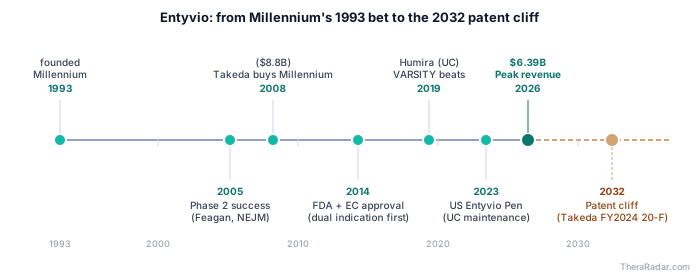
The $6 billion peak (and the cliff)
Entyvio is Takeda's single largest product. Reported sales grew from $4.07 billion in fiscal year 2021 to $6.39 billion in fiscal year 2026 — a 57% increase over five years, and the growth rate has not flattened a decade into the product's commercial life. (Takeda's fiscal year ends March 31; FY2026 = April 2025 through March 2026.)
Three drivers explain the recent trajectory. First, subcutaneous penetration via the Entyvio Pen launches of 2023–2024. Second, continued first-line penetration in biologic-naïve UC as gastroenterologists become more comfortable with the slow-onset profile in non-acute disease. Third, foreign exchange and price dynamics during the year supported the reported headline. Geographically, the United States remains the largest market for Entyvio by both volume and revenue; Takeda materials describe Entyvio as the number-one IBD product by market share in the US.
The franchise faces two separate clocks. Regulatory exclusivity expired first — the EU's 10-year biologic data protection ran out in May 2024, and the U.S.'s 12-year BPCIA window closed in May 2026. Biosimilar developers can already file abbreviated applications referencing Takeda's pivotal data. Patents are the second wall: Takeda's most recent FY2024 20-F describes Entyvio as facing "regulatory exclusivity in the later half of this decade and certain patents expected to expire in 2032," with biosimilar timing still uncertain. Our patent landscape analysis identifies additional method-of-use and formulation patents extending portions of the thicket to 2036, though not all are necessarily biosimilar-blocking. Biosimilar entry typically lands mid-window via negotiated settlement; the Humira precedent saw biosimilars enter roughly seven years past composition expiry under licensing agreements with AbbVie.
The biosimilar field is filling in early. Polpharma Biologics is running Phase 3 trials of PB016 and has secured commercialization partners in Fresenius Kabi and MS Pharma (deals announced in August and September 2025). Alvotech started a Phase 3 trial of AVT16 in September 2024. Samsung Bioepis is at preclinical stage with SB36 and has signed a global license/co-development with Sandoz.
The likely shape of the biosimilar curve sits closer to Stelara than to Humira. When Stelara lost US patent protection in September 2023, multiple biosimilars launched within months, and Q1 2025 Stelara sales fell 33.7% year-over-year to $1.08 billion. Humira, by contrast, saw drawn-out launches and a slow erosion curve protected by AbbVie's rebate-wall negotiation with pharmacy benefit managers. Vedolizumab biosimilar players are positioning years ahead of the 2031 composition expiry — Polpharma, Alvotech, and Samsung Bioepis all already in Phase 3 or pre-clinical — the Stelara playbook, not the Humira playbook.
For Takeda, the practical implication is that the current ~$6 billion franchise is running its peak years now. The growth from FY2021 to FY2026 is the trajectory into the cliff, not away from it.
What this teaches
The standard pharma trade is selectivity versus power. Hit a single target precisely, accept lower efficacy than a broader-acting drug, and trade some clinical reach for a cleaner safety profile. Vedolizumab inverted that trade. By dropping α4β1 from the molecule and keeping only α4β7, it lost essentially no efficacy in IBD, removed the PML risk, and became eligible for first-line use across both UC and Crohn's. The more specific drug became the more broadly usable one.
The pattern recurs across TheraRadar's catalog. Casgevy does not fix the sickle cell mutation; it reactivates fetal hemoglobin instead, taking a longer route to the same clinical goal because the indirect route turned out to be safer and more durable. Tepezza succeeds in thyroid eye disease where two decades of IGF-1R cancer trials failed — same target, different biological context. In each case the counter-intuitive bet — that the more specific or more indirect mechanism would win — paid out.
The Entyvio playbook applies wherever a tissue has a unique address code. The gut got MAdCAM-1, and α4β7 selectivity exploited it. Skin lymphocyte trafficking has its own homing receptors (CCR4, CCR10, CLA); lung-resident memory T cells use distinct integrins; joint-homing autoreactive T cells in rheumatoid arthritis target ICAM-1 and VCAM-1 patterns. None of those has yielded an approved drug with anything like the clean selectivity story of vedolizumab.
And the failed integrin competitors are the cautionary half of the lesson. Etrolizumab's β7-dual-blockade hypothesis and ontamalimab's MAdCAM-1 antibody approach were both biologically rational extensions of the same selectivity insight. Both failed in late-stage trials. Mechanism alone does not guarantee a follow-on win. Execution, trial design, patient selection, and market timing all matter, and the modern Phase 3 environment is less forgiving of marginal effect sizes than the environment vedolizumab was approved in.
Eleven years after Entyvio launched as the first biologic to span UC and Crohn's, it remains the only gut-selective IBD drug a gastroenterologist can prescribe. That is both a testament to the original bet Millennium made in the late 1990s and a warning about how narrow the addressable design space turned out to be.
References
Primary sources & SEC filings
- Takeda — FY2024 Form 20-F — patent & exclusivity outlook
- Takeda — Q4 FY2025 Quarterly Financial Report — FY2026 ENTYVIO JPY 958B
- Biogen Idec — Feb 28, 2005 8-K — Tysabri voluntary suspension
- Takeda — FDA approval press release (May 20, 2014)
- Takeda — European Commission approval press release (May 22, 2014)
- Takeda — Entyvio Pen UC press release (September 2023)
- Takeda — Entyvio Pen Crohn's press release (April 2024)
- Spyre — SPY001 SEC 8-K data release
- FierceBiotech — Takeda–Millennium acquisition (April 2008, $8.8B)
Clinical trial registrations
- GEMINI 1 — NCT00783718 — Vedolizumab in UC, Phase 3
- PB016 — NCT05771155 — Polpharma vedolizumab biosimilar, Phase 3
- AVT16 — NCT06570772 — Alvotech vedolizumab biosimilar, Phase 3
Pivotal publications
- Feagan et al. — MLN02 Phase 2 in UC (NEJM 2005)
- Feagan et al. — GEMINI 1 results (NEJM 2013)
- Sandborn et al. — GEMINI 2 results (NEJM 2013)
- Sands et al. — GEMINI 3 anti-TNF Crohn's (Gastroenterology 2014)
- Sands et al. — VARSITY head-to-head (NEJM 2019)
- Loftus et al. — Post-marketing safety analysis (470k PY) (2018)
- Loftus et al. — GEMINI LTS, 7,999 PY follow-up (Aliment Pharmacol Ther 2020)
- 2025 post-authorization safety study (5,008 patients)
- Biogen — 541 cumulative PML cases in natalizumab (NEJM 2015)
Mechanism reviews
- von Andrian & Mackay — T-cell function and migration: two sides of the same coin (NEJM 2000)
- MAdCAM-1 biology review (Frontiers in Immunology 2019)
- α4β1/VCAM-1 blood-brain barrier capture (JCI)
- α4β7 imprinting in Peyer's patches (JCI)
- Carotegrast methyl review (Drugs 2022)
Guidelines
Failed competitor coverage
- Roche — Etrolizumab Phase 3 program announcement
- FierceBiotech — Etrolizumab August 2020 mixed readout
- FierceBiotech — Roche discontinues BERGAMOT (February 2022)
- Ontamalimab TURANDOT Phase 2 LT extension (UC)
- Ontamalimab OPERA Phase 2 LT extension (Crohn's)
- FIGARO & CARMEN Phase 3 discontinuation review (JCC)
Background & context
- Vedolizumab — Wikipedia
- Millennium Pharmaceuticals — Wikipedia
- Progressive multifocal leukoencephalopathy — Wikipedia
- Tysabri TOUCH program re-approval coverage (MDedge)
Related TheraRadar reading: TL1A: The Target Behind the $18 Billion Bet — what every approved IBD drug, including Entyvio, doesn't do (touch fibrosis). Casgevy Doesn't Fix the Sickle Cell Mutation — the indirect-path-was-safer pattern. IGF-1R — same target, different biology.
Go deeper with Pro
Pro gives you the data — patent cliffs, trial analytics, competitive landscapes, revenue tracking. Briefs tell the story with the data. Launch pricing: $99/month.
See Pro plansGet the next Brief in your inbox — free
Every drug has multiple stories. Most never get told. One brief every week. No spam.
Archive at /briefs/. Unsubscribe anytime.